New media forms have successfully eroded the divisions between leisure and labour. Fuchs, Christian states that, “The basic argument is that the internet usage is a new form of labour conducted beyond factory and office boundaries in a playful manner and that online companies appropriate this labour and make profit out of it”(Fuchs, Christian, 2015). We are participating in labour as the product and as the consumer, therefore we gain leisure however the company gains promotion of the product as well as profit from the usage created by the consumers. Mobile Legends: Bang Bang was released in 2016 as 5v5 mobile game and one of its features for success is the accessibility it provides for players as it engages with beginners and is a mobile game which means it can be played anywhere the player is situated.
This blog’s aim is to emphasise that the audience of a product are both the consumers and the product that create a consumption of digital media as labour. Firstly, Mobile legends takes part within the Esports industry. Esports is the most popular in Asia however it is growing in popularity in the EU and USA, as the tournaments in mainstream games are worth millions and it allows players to become famous, national, and even global players. As Mobile legends allows players to participate in tournaments, it creates profit for the company (Moonton), as these players gain views from fans and views through external apps, such as YouTube as well as through the Esports streaming. The players gain popularity and interactions as well as leisure through playing what they like, illustrating they’re consuming the game as well as promoting it to viewers which is labour, this suggests pro players are exploited and self-exploited just as all other forms of labour. Secondly, the game has in game streaming for players who want to create a fan base within the game this is done by the players enabling their microphones and stream access, and with a gifting feature, fans can buy in game currency (diamonds) and gift it through the player’s stream that they are watching, and these diamonds are converted to the streamer. Therefore, the fans are paying Moonton to support their friend’s/ idol’s streams.
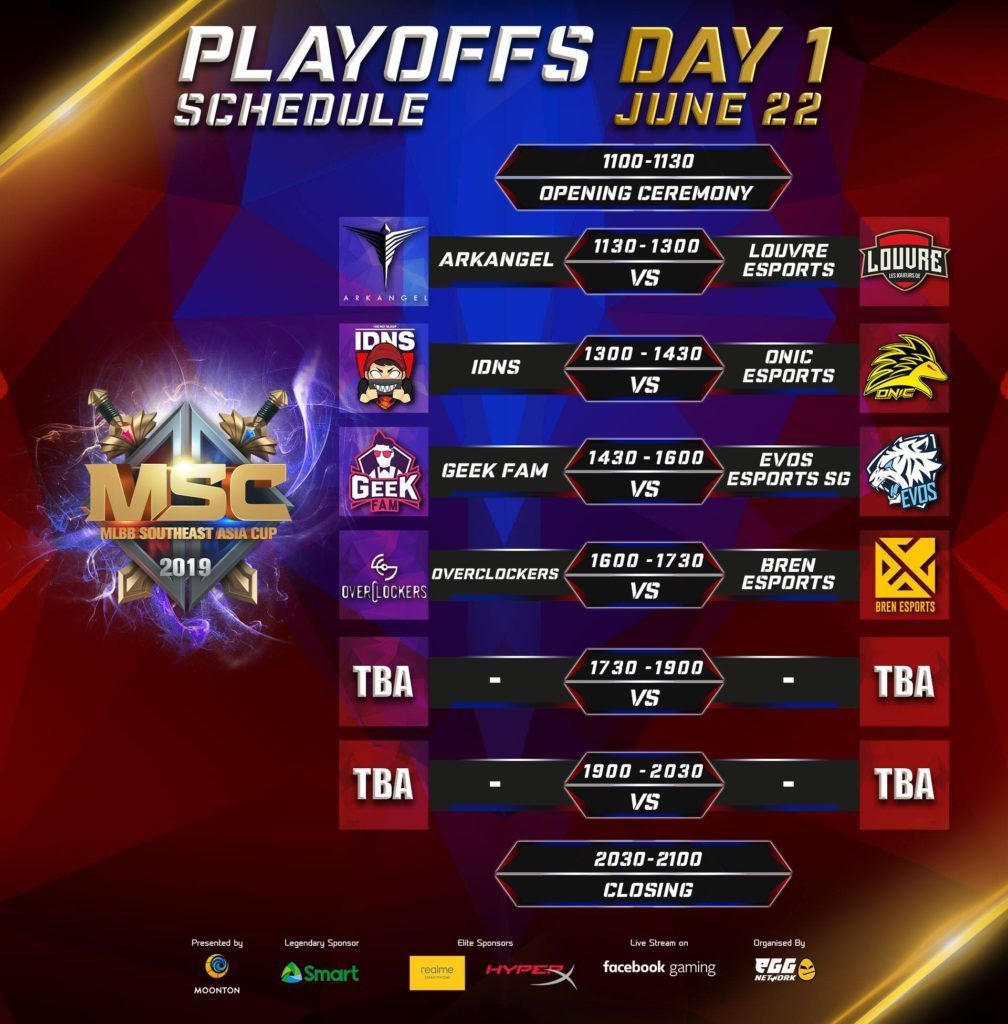
Games are often designed intentionally and unintentionally, around feedback reward loops that keep us playing as well as winning produces pleasure which keeps us engaged in the game, this is why Mobile Legends has weekly competition “MSC” where players play against each other until one team is left and wins an in-game trophy and a badge on their profile and winners are rewarded with “exclusive skins” that everyone competes for.
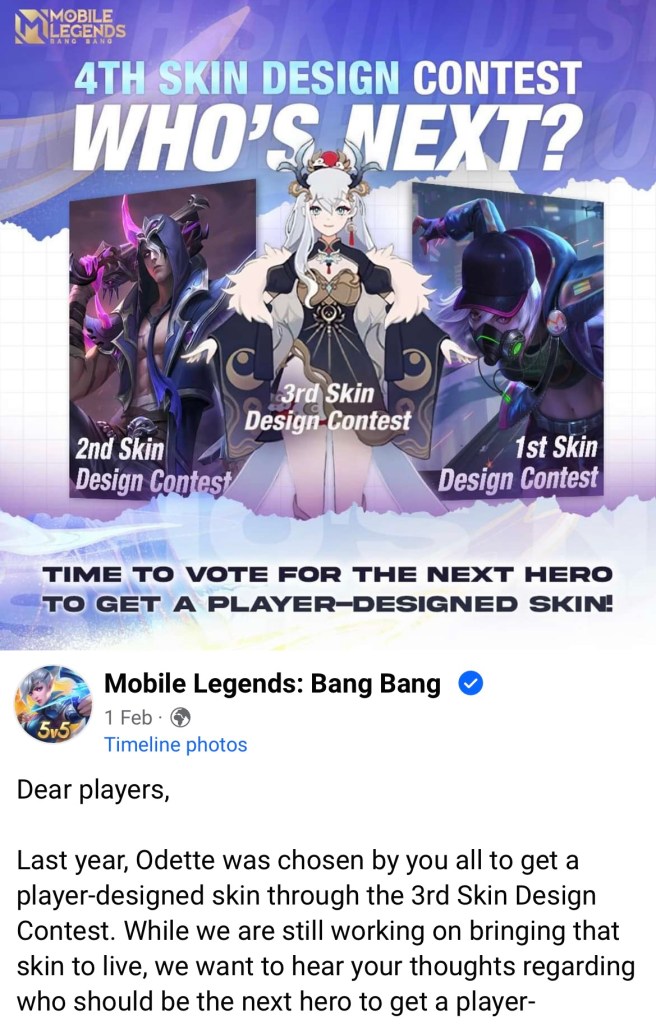
Players are given a chance to create a skin for heroes through drawing digitally and entering a voting system by submitting their artwork for the skins, in which other players who play the game can vote for the best designed skin. After a design has been voted for and there is a winner, Moonton interacts with the designer and creates their skin in game for people to buy and promotes the artist. Therefore, the artist has gained promotion by working to create a skin and in exchange Moonton gains a free design and approval of in game players and when the skin is released, they gain a lot of profit. Moreover, Mobile legends has an “advanced server” where players get selected to test unreleased features of the game and provide “sneak peaks” as well as reviews of what might be updated into the game, which fans watch and provide their opinions and suggestions about it and these thoughts are carried out by the testers to Moonton to take into consideration. The testers are paid through in game currency for their contribution which they then can buy skins with, meanwhile Moonton gets first hand player’s opinions as well as their fans thoughts on the updates the game can go through, illustrating that the majority of players will be in favour of the feature when it`s released.
Dallas Smythe argues that the audience is engaged in labour in the consumption of television, “The audience performs the role of both product and labour of TV” (Smythe, D.W. 1977). This can be applied to mobile legends as players are given events to create edits for heroes they play and post them on apps such as Twitch, YouTube, Tiktok, which are approved by in game hired players to regulate and check if the edits pass the instructions given by the event, if they qualify they get rewards for the amount of views they gained and their edits are then published by the game onto the streaming platform to gain promotion.
Overall, it is evident that consumption of media as labour in terms of Mobile Legends is significant and plays a huge role in the company`s profit and promotion of their product as well as the growth of their economy through the usage of their audience, in which these audience are immersed in the leisure and rewards they gain from doing the ‘labour’.
Reference list:
Fuchs, Christian. Culture and Economy in the Age of Social Media, Taylor & Francis Group, 2015.
Smythe, D.W. (1977). “Communications: Blindspot of Western Marxism”., Canadian Journal of Political and Society Theory 1 (3): 1-28.
 Consumption of Digital media as labour in Mobile Legends: Bang Bang
Leave a comment